- Kyle Zeng said his team's pipeline validated 948 Linux privilege-escalation flaws, against about 10 competition demonstrations he made himself.
- He said these were the easier bugs, and that deeper ones would need a better model or a smarter pipeline.
Kyle Zeng, a cyber researcher, said on OpenAI's show that his team's AI pipeline validated 948 Linux kernel flaws. The episode is "Investigating Linux Vulnerabilities with GPT-6 Cyber". He said these were the easier bugs to find.
What was said
The 948 are local privilege escalation flaws, known as LPEs. In plain terms, they let an ordinary user take full control of a machine. Zeng said he had around 10 successful demonstrations at hacking competitions, and that about 20 would have been a huge number for a very successful researcher before AI.
Then he gave his verdict on the new total: "Now, 948 LPEs, not just potentially exploitable exploits, is kind of like an insane number."
Zeng stressed that the flaws are not hypothetical. Validated means exploitable in practice, not a model's hunch. The pipeline also looks for variants of each flaw and drafts patches. The show notes say humans review those patches.
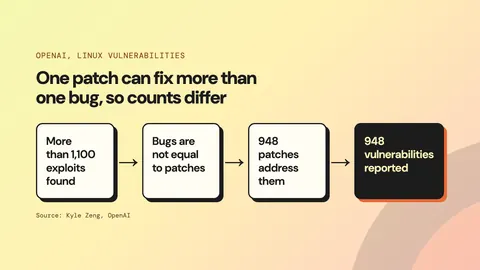
He added a counting warning. His team found more than 1,100 exploits, but reported 948 because that many patches fixed them. One patch can now cover several variants of the same flaw.
On what remains, he said: "So we essentially identify those easier to find bugs." He believes deeper issues exist and may need a better model or a smarter pipeline.
Why it matters
Zeng's own figures put 948 at roughly 50 to 100 times his 10 to 20 competition demonstrations. That ratio is our arithmetic, not his claim. Our reading is that this shows what skilled people can now do with AI, and a skill multiplier is not limited to defenders. Anyone with the expertise and the tools could in principle scale the same way.
Flaws can be found faster than before, so slow patching is a larger exposure. Zeng said the focus of his work was "saving maintainer time". We infer that fixing, not finding, may now be the constraint, so it is fair to ask vendors how quickly they can absorb a flood of fixes.
The other side
The comparison is imperfect. A competition tally and a pipeline run are different kinds of work, and the 948 counts patches, not every exploit found. The 948 comes from OpenAI's own show, so it is the team's claim.
Host Clint Gibler said the work is a human expert-driven, iterative process, not simply a test of whether AI can do it. Zeng did not claim his patches are flawless, and the excerpts do not show them merged. His view that deeper bugs exist is a belief, not something the episode demonstrated.
Written by the WebPulse Newsroom with AI assistance, and checked by our editorial review: every quotation was verified against the recording's transcript. How we use AI.
The conversation this talking point comes from
- OpenAI: Investigating Linux Vulnerabilities with GPT-6 Cyber (2026-11-23)