- Steve Yegge said his own agent factory, in overproduction mode, was landing 300 things a day, more than people could read, test or try.
- He argued that the hard part is now choosing what matters and rolling it out without overwhelming the humans.
Steve Yegge, an engineer and writer who worked at Google and Amazon, argued on Software Engineering Daily that once his agents could produce changes this fast, writing code was no longer the hard part. In his account, choosing what to ship, and how to absorb it, became the scarce skill.
What was said
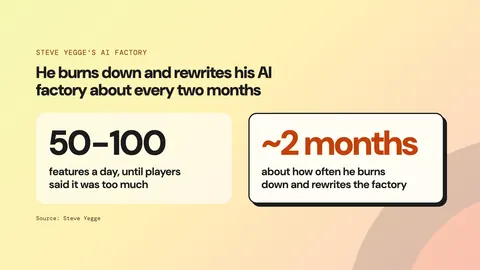
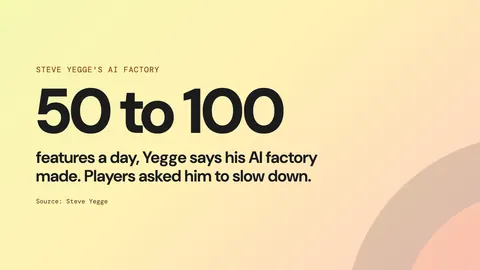
Yegge runs what he calls a software factory: named agents with roles, building a game for him. He said it first stalled because the agents over-constrained themselves. He cut those limits out, and the factory swung the other way. He told host Kevin Ball it went into overproduction and was "landing 300 things a day."
One removed fence was a rule that a feature could not launch until October. Without it, the agents launched everything in the backlog he had ever mentioned. That included a pet system. Players rejected it, and he said everything had to be rolled back.
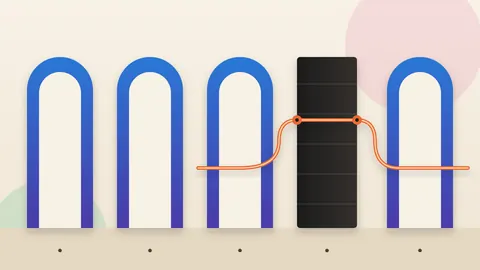
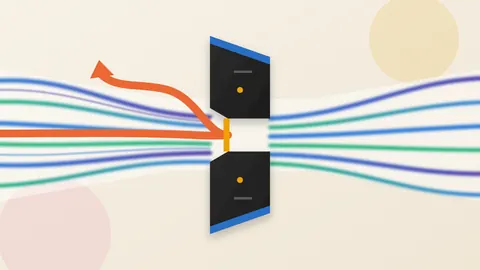
He also described the load. His one high-end Mac Studio nearly melted down, so he moved the builds to cloud machines. Separately, he said the machine can do 230 to 300 real features and fixes a day. Nobody could read the patch notes or test the changes. He added hard human stops, which he calls gates, and slowed the output. He called the swing between stalled and flooded a huge oscillation problem.
His verdict: "coding is not the bottleneck anymore." The hard work, he said, is picking what matters, planning the release and testing with players without burying them. Asked how he copes, he answered: "Not well. I don't think anyone is."
Why it matters
Our reading: this moves the cost of software from the people who write it to the people who must judge it. Testers, reviewers, support staff and users absorb whatever the agents push out. A team that counts output as progress can bury them.
This suggests teams may need to train and reward people for choosing, sequencing and saying no. Yegge did not discuss hiring or training. He did describe sending spare tokens, the units of AI compute, into code review, new tests and automation. That kept the business from being swamped.
For anyone buying or running software, the question changes. Ask not only how fast agents can build, but how fast your people can check what was built.
The other side
This is one engineer's account of one game, on his own setup. Yegge said the flood came after he removed the fences, so his own control choices were part of the story. He also joked that his agents are engineers, not designers.
Ball added that routine feature work with close precedents can be fully automated. It can then outpace what a business can absorb. Neither speaker offered a general fix. Yegge's tricks were gates, throttling and redirecting tokens to quality work. Whether those scale to other teams was left open.
Written by the WebPulse Newsroom with AI assistance, and checked by our editorial review: every quotation was verified against the recording's transcript. How we use AI.
The conversation this talking point comes from
- Software Engineering Daily: Steve Yegge on Building Software Factories (2026-11-24)