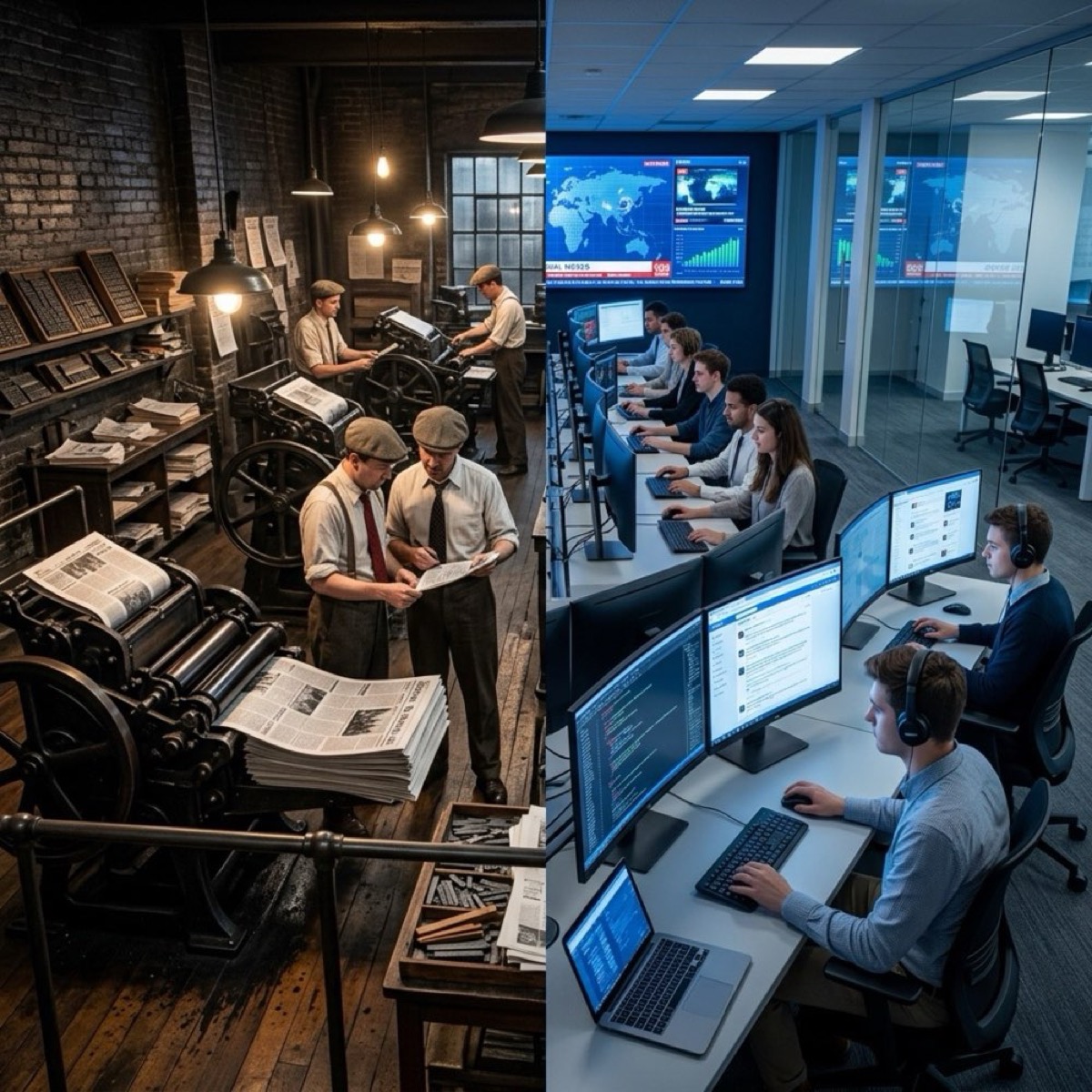
For most of computing history, a senior engineer was, among other things, a well-stocked warehouse. Years of accumulated syntax, idioms, API trivia, and pattern libraries — expertise you could almost measure by volume. Interviews tested the inventory. Careers were built on it. The programmer was, in a real sense, a vessel of knowledge, and the fuller the vessel, the more valuable the engineer.
That model of expertise is now dissolving — not because the knowledge stopped mattering, but because it stopped being scarce. When any editor can summon syntax, patterns, and first-draft implementations on demand, the vessel's contents are a commodity. What remains scarce — and is becoming more valuable, faster than most career plans have noticed — is something else entirely: the capacity to orchestrate. To understand the parts and how they fit, to maintain the integrity of the whole, and to decide what actually matters.
I want to spell out what that shift means concretely, because "orchestration" can sound like a euphemism for doing less. It's the opposite.
The second engine
The accurate picture of AI-assisted development isn't replacement, and it isn't autocomplete. It's a hybrid cognitive system: two engines running in parallel. The machine engine surfaces patterns, stitches APIs together, regenerates forgotten constructs, and drafts first-pass solutions at extraordinary speed. The human engine does what the machine one can't: interprets, integrates, restructures, discards, and — above all — supplies intent. One engine produces possibilities; the other gives them structure and purpose.
Notice where the leverage sits in that system. The machine's output is only as valuable as the human's ability to direct, filter, and assemble it. A powerful drafting engine coupled to weak judgment produces sophisticated-looking systems with nobody home — volume without architecture. The same engine coupled to strong judgment produces something formidable. The multiplier is entirely on the human side, which is why the orchestrating role is a promotion in cognitive terms, not a demotion. The keystrokes were never the job. Now that's undeniable.
The masters of this arrangement share a recognizable profile: they hold deep, durable mental models of their systems while offloading everything that interferes with holding them. Every recall task, every boilerplate chore, every syntax lookup — delegated, precisely to protect the scarce internal resource: the live model of how the system works and why. They treat the assistant as a cognitive prosthetic — fast, tireless, genuinely integrated into how they think — while never forgetting the one thing it cannot do: determine whether the result is actually right for this system, this context, these constraints. Semantic correctness, coherence, appropriateness — the final judgment stays human because it is the human contribution.
The curriculum is pointed at the wrong decade
Now hold the education system up against this picture. Overwhelmingly, we still teach programming as vessel-filling: semesters of syntax, language features, memorized patterns — the exact inventory whose scarcity just collapsed. Meanwhile the capabilities the hybrid era actually demands are taught incidentally if at all: problem decomposition, architecture, interface design, state management, failure modes, constraint negotiation, test construction, security thinking, long-term maintainability. The stuff of systems, not syntax.
The reorientation I'd argue for goes deeper than swapping course modules. It's a change in what we treat code as. In the vessel era, code was the destination — the thing you were learning to produce. In the orchestration era, code is one representation of thought among several — alongside architecture diagrams, interface contracts, constraint lists, and test suites — and often not the most important one. The durable skills are the ones that survive any particular representation: decomposing a messy problem, reasoning about a system you can't hold in one view, and critically evaluating an artifact you didn't produce. That last one deserves special emphasis: reading, adapting, and modifying generated work is now a daily core activity, and we teach it almost nowhere. It should be a first-class subject — the way editing is taught to writers, not assumed as a by-product of writing.
There's a warning embedded here for learners taking the tempting shortcut, too: studies of students working with AI assistants keep finding the same signature — faster completion, thinner understanding, learning gains that barely move. Fluency of output is masking absence of model-building. An education that optimizes for the output is training people for the commodity half of the hybrid system. The market will price that accordingly.
What I'd bet a career on
If I were starting out today — or advising someone who is — the strategy follows directly from the structure. Don't compete with the external memory; you will lose, and the contest is worthless anyway. Invest everything in what compounds on the human side of the hybrid: systems reasoning, architectural sense, the discipline of maintaining accurate mental models amid rapid change, and the judgment to evaluate what machines produce. Learn syntax as you need it — it's on tap now — but learn structure deliberately, because nobody serves it on demand.
And if you manage engineers, update what you honor. The metrics of the vessel era — speed, volume, breadth of memorized stack — now measure the commodity. The scarce contributions are the ones without dashboards: the design that didn't need rework, the generated module someone caught before it shipped, the mental model that let one person trace a failure through four services. Find ways to see that work, or you'll optimize your team toward exactly the half of the system that's already free.
The vessel era is ending, and I find I don't mourn it. Filling human heads with what machines now store was always a means, never the point. What's left when the storage moves out is the irreducible core — understanding systems, directing intent, exercising judgment — the part that was always the actual profession. The programmer isn't being replaced. The programmer is being distilled.