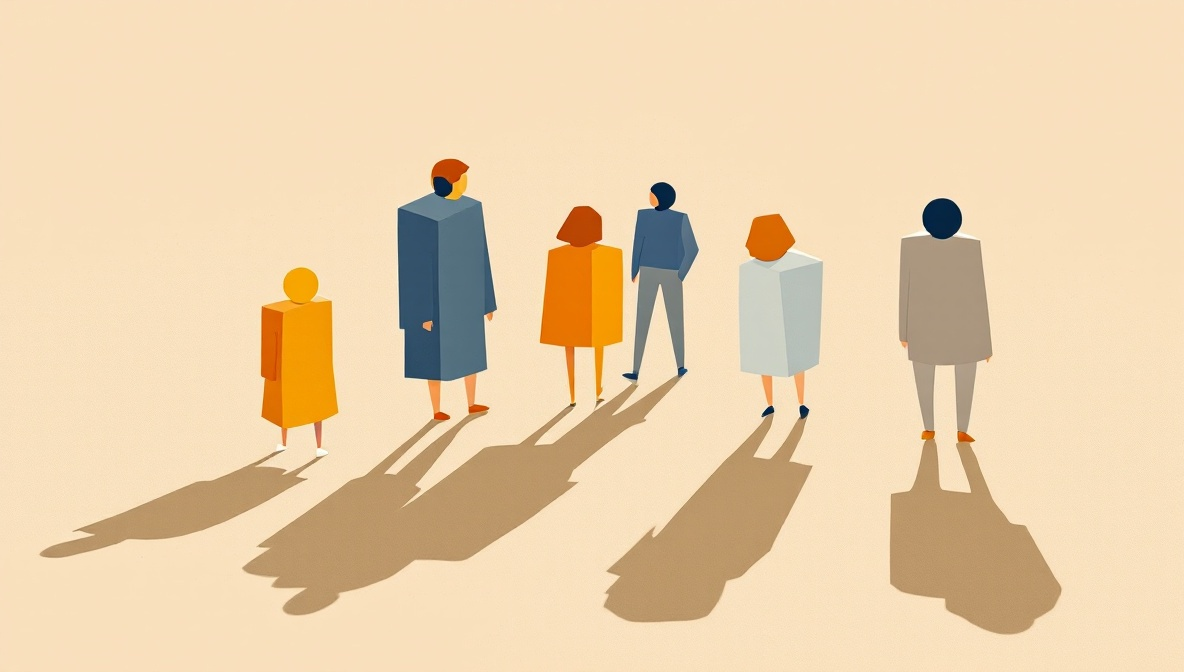
Picture a street corner where two cars have just collided. A handful of strangers converge — people who have never met, will never meet again, and share no plan. Within seconds, they self-organize: one checks on the victims, one calls emergency services, one steps into the road to direct traffic. Nobody elects a leader. Nobody negotiates a protocol. A team simply forms, does its job, and dissolves.
Or take something lighter. Travel to a country where you don't speak the language, find a pickup soccer game, and wave. You can be playing — usefully — within a minute. You'll size up the field as you go: Am I the strongest player here or the weakest? Nobody's playing defense — should I? You adapt your role in real time to make the team better, coordinating fluently with people you cannot even talk to.
This capacity is so ordinary in humans that it's nearly invisible. And it is almost entirely absent from our machines. There's a name for the research problem — ad hoc teamwork: the challenge of building an agent that can drop into a team it has never seen and cooperate effectively, on the fly. I think it's one of the most important unsolved problems in AI, and one of the most underrated.
Why our machines can't do this
Consider how multi-agent AI systems have traditionally become teams. Either the agents train together — thousands of hours of shared learning until their behaviors interlock like gears — or they're handed a common protocol, a hand-coded playbook every agent follows. Both approaches produce real coordination, and both share a fatal assumption: the team is known in advance.
Change one teammate and the trained team's interlocking gears no longer mesh. Introduce an agent built by someone else, on a different stack with different conventions, and the shared playbook doesn't exist. The coordination was real, but it was closed-world coordination — brittle exactly where human teamwork is robust.
Now look at where autonomous systems are actually headed: roads shared by vehicles from a dozen manufacturers; warehouses mixing robots from different vendors with human workers; disaster sites where whatever robots survived the event must work with whatever robots arrived with the responders; software agents from different companies negotiating in the same marketplace. Nobody controls the roster in any of these settings. The open world is the deployment environment, and in the open world, "we trained together" is a luxury you will rarely have. It's worth adding that many multi-agent settings aren't even cleanly cooperative or adversarial — an autonomous car isn't allies or enemies with the car beside it; they're just self-interested agents sharing a space. Teammates, opponents, and neutral strangers blur together, and an agent has to navigate all three at once.
What the pickup game actually requires
Unpack the soccer traveler's minute of adaptation and you find a dense stack of capabilities. Rapid teammate modeling: inferring, from observation alone, what each teammate can and can't do — who's fast, who can't kick with their left, who never passes. Honest self-assessment: locating your own abilities relative to the group, because the best action for the strongest player on the field is the wrong action for the weakest. Role inference: seeing which functions the team needs that nobody is filling, and filling them. Conventionless communication: coordinating through action itself — positioning, timing, demonstration — when no shared language exists. And all of it fast, from a handful of observations, not a training run's worth.
That last constraint is the brutal one. Most machine learning improves with mountains of experience gathered over hours or days. The pickup game gives you seconds and a glance. Closing that gap — few-shot adaptation not to a dataset but to other minds — is the heart of the problem, and experimental progress remains early: demonstrations in narrow scenarios, agents detecting that an opponent favors one side of the field and adjusting, that sort of thing. The general capability doesn't exist yet.
The deeper claim: intelligence is social
Part of why I find this problem so compelling is the view of intelligence underneath it. A case that multi-agent researchers have been making for decades — and that I've come to fully believe — is that a huge share of what we call human intelligence is our ability to interact: to read other agents, predict their behavior, decide whom to trust and cooperate with from body language and a few seconds of observation. Intelligence didn't evolve in isolation; it evolved in groups, and much of its machinery is machinery for dealing with other minds.
If that's right, then a single autonomous agent — however individually capable — is never complete. And the current AI moment has a blind spot here. We are building ever-more-capable individual agents and largely assuming the teamwork part will sort itself out. The history of multi-agent research suggests it won't: coordination is not an emergent freebie; it's a first-class engineering problem. An ecosystem of brilliant agents that can only cooperate with copies of themselves is an ecosystem of brilliant strangers standing around a car crash, each waiting for the others to have trained with them first.
The test I'd hold us to
Benchmarks for AI teamwork tend to measure teams that trained together — the closed world, again. The bar I find more honest is the pickup game test: drop your agent into a team it has never seen — different builders, different conventions, no shared training history — and measure whether the team gets better because your agent showed up. Not whether your agent is individually impressive: whether it makes the team shine.
It's a humbling test; today, almost everything fails it. But it points at the capability that will actually matter as autonomous systems fill the world — because the world is a pickup game. Rosters change, protocols are missing, strangers arrive constantly. The humans at the car crash didn't need a shared training run to save a life. The machines we're building will need to clear that same bar, and we should start grading them against it now.