- Steve Yegge says each model generation builds something slightly too big for it to handle, and the next one wants to burn it down.
- He rebuilds his AI software factory about every two months, so old code can arrive within months, not years.
Steve Yegge, creator of Beads and Gas Town, argued on the AI Engineer show that AI-built software tends to outgrow the model that wrote it. He described a repeating cycle: a model builds something impressive, the code becomes a mess, and he starts over. That is one builder's account, but the pattern has a cost for anyone who buys or runs AI-built systems.
What was said
Yegge said the cycle hit both Gas Town and Wheelhouse, a software factory he built for his own online text game, which has run for decades. He described a phase where the models get excited and build something cool. Then, in his words, "it just turns into garbage mountain every single time."
His explanation was about scale. He said "every model generation comes in and can build something that's just a little too big for it to handle." The next generation then looks at the result and decides it must be burned down.
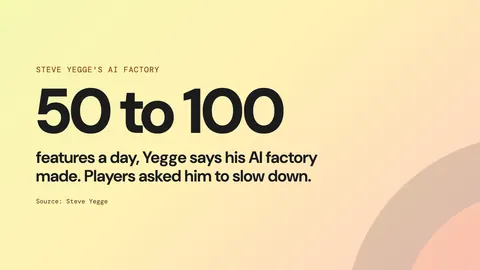
He gave two examples of how the pile grows. His factory had been producing 50 to 100 features a day, and his players asked him to slow down. He also said the agents resist deleting anything. Everything he says is written into a record that only grows, and he found the agents reluctant to remove old material.
His fix is to bring in another model to cut aggressively, but he called the effort enormous. He said he has to burn the factory down and rewrite it about every two months.
Why it matters
Our reading: the old story of legacy software was slow. Code aged over years, and the bill came later. Yegge describes a version where the clock runs in months, because the builder creates more than anyone can maintain.
For leaders who buy or run AI-built software, that suggests a few questions. Who deletes things? Who plans the rewrite? Who pays for the cleanup? Output speed alone says little about what you will carry afterwards. Yegge also said that the more agents he deploys, the more humans he needs. People are still part of the cost.
The other side
This is one person's experience with his own game and his own factory. He gave no measured cost of the rewrites and no comparison with human-built software. Nothing in the talk shows the pattern holds for other teams or larger systems.
Yegge also did not call the cycle a failure. He said his factory is smooth now, despite the rewrites, and his players liked the new features. The open question is whether later models will clean up after themselves, or whether the rewrite cycle is simply the price.
Written by the WebPulse Newsroom with AI assistance, and checked by our editorial review: every quotation was verified against the recording's transcript. How we use AI.
The conversation this talking point comes from
- AI Engineer: Software Factories: Escape from Trash Mountain — Steve Yegge, Gas Town (2026-11-24)