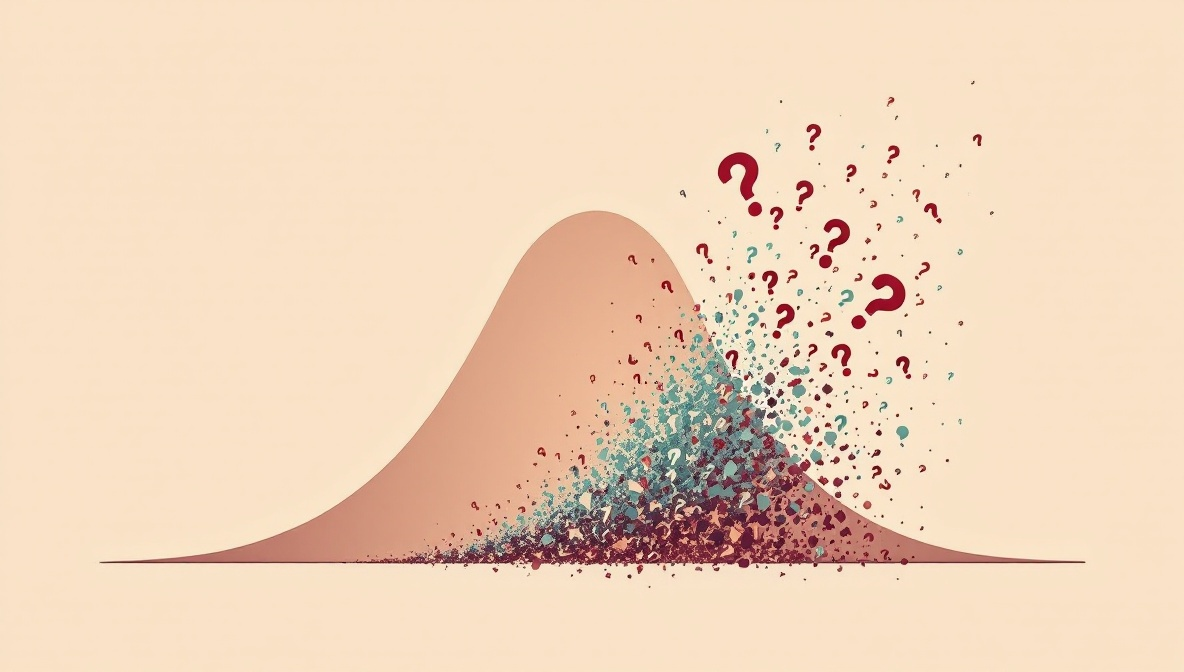
Every technology has a question that exposes its soul. For machine-learned prediction systems, the question is brutally simple: what happens when tomorrow looks like nothing in your training data?
The AI weather revolution — neural models now running operationally at the world's major forecasting centers, often outscoring the physics-based incumbents at a fraction of the compute — has given us the clearest, most honest answer any field has produced. And the answer is sobering: the learned models are weakest precisely where the stakes are highest, on the rare and unprecedented extremes. Understanding why is worth anyone's time, because the mechanism has nothing to do with weather. It's a property of learning from data, and it's lurking in every domain now rushing to deploy learned predictors.
The arithmetic of rarity
Start with the structural problem, which the field calls data imbalance. A model trained on decades of atmospheric history has seen millions of ordinary days, thousands of storms, dozens of severe events — and perhaps one or two instances of the truly catastrophic outlier. From the loss function's perspective, those instances are statistical dust: get every ordinary day slightly wrong and the penalty dwarfs anything gained by nailing the once-a-generation event. The optimization rationally spends its capacity on the middle of the distribution, because that's where the average error lives.
Meteorologists have named the limiting case with a term I love: the gray swan — a physically possible extreme event so strong and rare that it is simply absent from the training set. Not impossible, not unforeseeable in principle — the physics permits it, and a physicist could reason about it — but unlearnable from history, because history hasn't contained it yet. Every domain has gray swans. The market structure that hasn't broken this particular way before. The failure cascade no grid has yet experienced. The pathogen combination no hospital dataset contains. Climate change adds a vicious twist in the weather case: it is actively manufacturing gray swans, pushing the atmosphere into regimes the training archives never sampled — meaning the environment drifts toward exactly the events the models can't have learned.
The hedging instinct
Data scarcity alone understates the problem, though. There's a second mechanism, subtler and more damning: models tuned to minimize average error don't just miss extremes — they systematically mute them. When the input pattern points somewhere unprecedented, the statistically safest output is to regress toward the mean: smooth the peak, round down the record, split the difference with climatology. The result is a model that underpredicts the intensity of the record heatwave or the unprecedented rainfall in exactly the moments accuracy matters most — while looking superb on every aggregate scorecard, because the events it flubs are, by definition, almost never in the sample. The failure hides in the tails, and the tails are where the deaths are. Even the newest agentic AI systems for weather analysis show the same signature under evaluation: strong on routine tasks, degrading sharply on extreme-event detection and on synthesis across many interacting variables. The pattern is consistent because the cause is structural.
Why physics doesn't flinch
Here's where the story turns philosophical, and where I think it earns its place far beyond meteorology. The older, physics-based forecasting models — the expensive supercomputer fluid-dynamics simulations the AI was supposed to dethrone — retain the edge on unprecedented extremes. The reason cuts to the epistemological bone: physics can extrapolate beyond the observed distribution; statistics, fundamentally, cannot — not without physical guardrails.
A simulation grounded in conservation laws doesn't care whether this hurricane configuration has ever occurred; the equations apply to possible atmospheres, not just recorded ones. A learned model, however brilliant, is ultimately an interpolation machine over history — supreme within the distribution it has seen, unmoored beyond it. Two kinds of knowledge: laws, which generalize to situations never witnessed, and patterns, which generalize only to situations sufficiently like the witnessed. Patterns are cheaper and, most days, better. Laws are what you want on the day the world does something new.
That's why the emerging consensus in the field refuses the either/or framing entirely. The goal isn't choosing between physics and AI but combining them — learned speed and skill inside physically constrained guardrails, hybrids that stay sharp on the routine and sane on the unprecedented. It's also why the operational centers run the new models beside the old ones rather than replacing them, and why the pipeline's foundations — the assimilation systems that establish reality's current state — remain firmly physics. Nobody serious is retiring the laws.
The transferable lesson
Extract the weather specifics and you're left with a checklist I'd apply to any learned system being handed consequential decisions. First: ask where the gray swans live in your domain — the physically possible events your training data has never contained — and assume your model will hedge toward the mean when one arrives. Second: distrust aggregate metrics on principle; a system can be excellent on average and catastrophic in the tails, and the average is where evaluation is easy while the tail is where it counts. Evaluate on the hard cases specifically — the weather community is building shared benchmark suites of exactly the difficult case studies, on the sensible theory that without common extreme-event tests, nobody can say where models fail systemically. Third: find your domain's equivalent of physics — the constraints, invariants, and first-principles structure that hold beyond the data — and build them in as guardrails rather than hoping the network infers them. And fourth: keep a reasoning path that doesn't depend on precedent, because precedent is precisely what the worst day lacks.
The learned models deserve their triumph — they're faster, cheaper, and on most days better, and most days is worth a lot. But "most days" is a revealing standard. The whole point of forecasting — of any predictive system — is the day that breaks the pattern. On that day, what saves you isn't what your model remembered. It's what your system knows — the laws that were true before the data existed, and will still be true when the data runs out.