- Microsoft Research found that long-running AI research agents stall in one family of ideas, and that extra compute did not close the gap between runs.
- Fork-and-Flush branches the agent and wipes each branch's chat but keeps files, scoring a normalized average of 0.78 against 0.47 for single runs across 13 tasks.
- Leaders should ask how many independent runs sit behind any agent result, and whether work products are stored apart from the conversation.
A long-running AI research agent that remembers everything can get stuck in its own reasoning. That is the practical lesson of a Microsoft Research study, reported by The Decoder on October 12. The agents did not run out of compute. They ran out of new ideas, and their own conversation history helped keep them there.
Same agent, same task, very different results
The researchers studied what they call "Autoresearch agents." These systems propose a solution, test it, read the feedback and refine it, over and over. Hours or days can pass in a single run.
They ran the same agent on the same task eight times. The final scores ranged from 68.3 to 100.0. According to the paper, those gaps persisted even with substantially more compute.
For a leader, this changes how to read an agent demo. One impressive result may show what a lucky run can do, not what the system typically delivers.
How an agent gets trapped in an idea basin
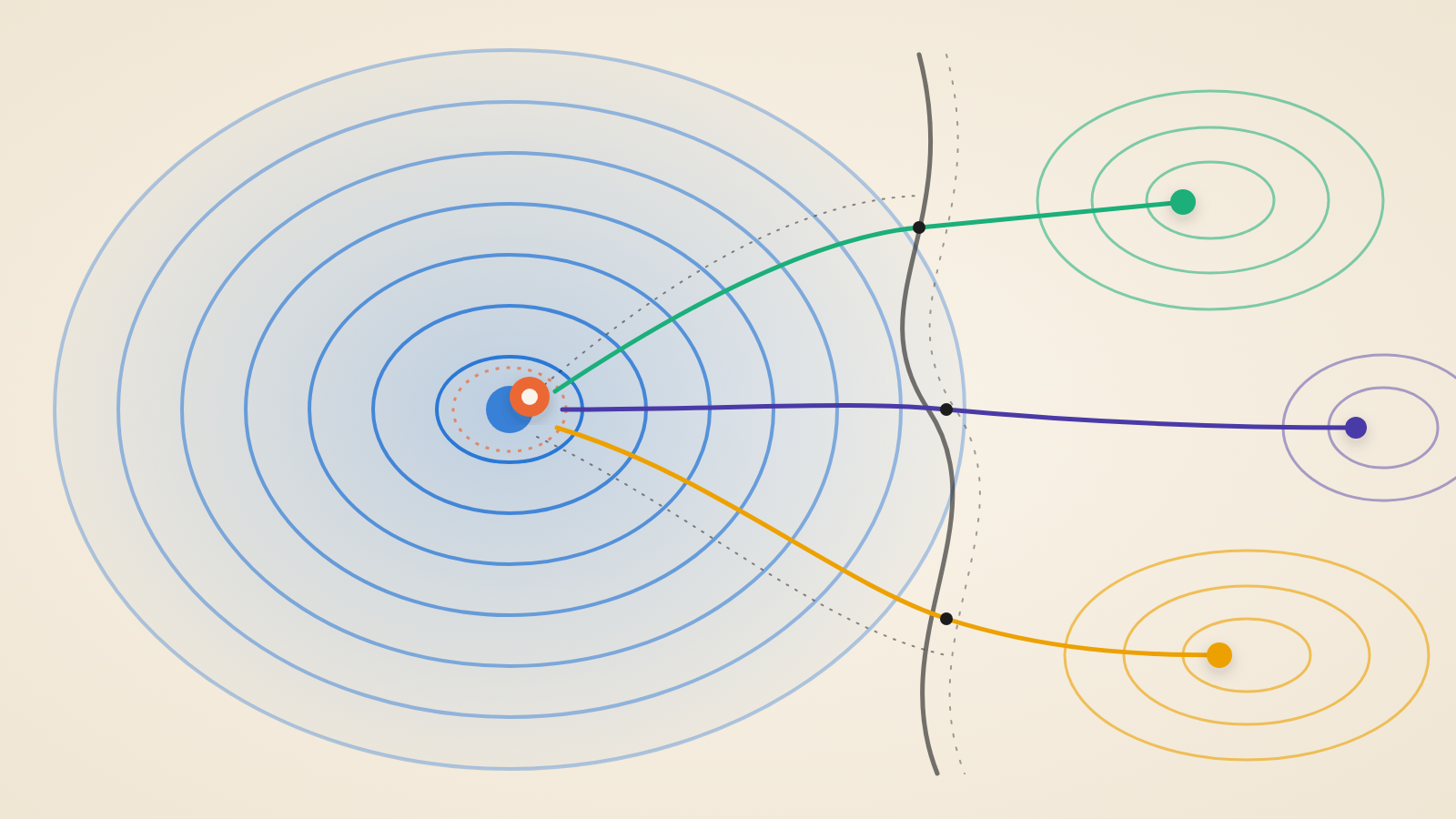
To see why, the researchers plotted every solution from every run on a two-dimensional map. Similar solutions sit close together. Within any one run, solutions almost always clustered in a small region. The authors call these regions "idea basins."
Once an agent settles in a weak basin, it keeps polishing there. The paper reports that agents pour much of their leftover compute into improving answers in that weaker area. Stronger approaches that other runs found go untried.
Compressing the chat history did not fix this. The agents summarised their past conversations, and the pattern held.
The mechanism is easy to picture. Every earlier step of reasoning sits in the agent's context and steers the next step. It resembles a team that has been in the same meeting room for six hours. Everyone is polite, everyone builds on the last idea, and nobody proposes a different one.
Fork-and-Flush: keep the work, drop the conversation
The proposed method has two parts. In "forking," the agent splits into K parallel branches. Each branch inherits the workspace and all generated files. In "flushing," each branch loses its entire chat context and starts a fresh conversation.
The code, files and saved results stay. Only the reasoning that pulled the agent toward the old idea is gone. The researchers say a branch that keeps the parent's chat tends to return to the same basin.
They tested the method on 13 long-running tasks, including job-shop scheduling, cryptanalysis and optimizing a VLIW kernel. The shortest runs took a few hours, and the longest passed 100 hours. Two models did the work, GPT-5.6-terra and GPT-5.5, and the team accessed both through the GitHub Copilot command-line tool.
Fork-and-Flush also beat best-of-4, which scored 0.54. On 12 of the 13 tasks, it came out ahead on average. Its results were more consistent too: normalized standard deviation fell to 0.16 from 0.26.
Will better models make this go away?
The researchers tested that on MAX-3-SAT problems with three Qwen3.5 model sizes: 4B, 9B and 27B. The spread between runs was widest on problems right at the limit of what a model could do. It was smaller on tasks well below or well above that point, which draws an inverted U.
In the authors' view, unsolved research problems are exactly the ones that models can only just manage. So the effect should show up there. They predict the spread will stay as models improve, with only the difficulty level where it appears moving higher. That is their forecast, not something they measured.
The limits matter too. The tasks were research and optimization problems, not business workflows. The Decoder's report does not say how the method performs on everyday enterprise work.
What leaders should ask
The broader idea is that memory is not free. We tend to treat an agent's long context as an asset. This study suggests it can also be an anchor. The durable value sits in the files and results, not in the chat.
Four questions follow for teams running or buying agents:
First, how many independent runs sit behind any reported result? A single run is one sample. Second, are work products stored apart from the conversation, so a run can restart with a clean slate? Third, does the team measure the spread between runs, or only the best score? Fourth, when a long run stalls, is the answer more compute or a reset?
Storing outputs separately from chat has a second benefit. It gives auditors something stable to review. The chat is disposable. The workspace is the record.
The takeaway: a stalled agent may need to forget how it got there, not think for longer.
Produced by the WebPulse Newsroom with AI assistance from the original reporting credited below, and checked against that source by our editorial review. How we use AI.
Original reporting: The Decoder.