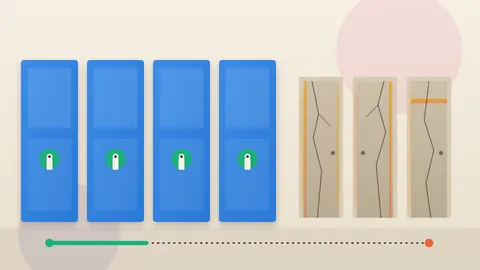
- Mistral released the open weights of Large 4 and says the model could give real attackers a boost.
- Mistral's science chief says safeguard updates go to its managed API and future releases, not automatically to downloaded copies.
- Teams that self-host take on the safety work. Ask who tests, monitors and adopts new checkpoints once the model runs in-house.
A safety feature that does not update itself
Most software gets safer after release because vendors push fixes. Open-weight AI works differently. Once a company downloads the model, it holds a fixed copy.
Mistral AI released the weights of Mistral Large 4, nicknamed "Le Chonk", on Thursday. It has 1 trillion parameters and reads images as well as text. Mistral says it improved sharply at coding and defensive security work.
The announcement also carries a caution. Mistral says it watched how people used the preview version for cybersecurity tasks. The model refused black-box attacks on live targets. Even so, Mistral wrote: "we see a potential for uplift to conduct real attacks."
The lesson here is plain. With open weights, control over the safety dial passes from the vendor to whoever runs the model. That is the appeal, and it is also the risk.
What Mistral can and cannot change
Mistral says it is adjusting the guardrails now and will keep revising them over the coming months. InfoWorld reports that these changes will not reach copies people have already downloaded.
Pierre Stock, Mistral's vice president of science, gave CSO the detail. The safeguards are built into the model's weights. Later updates go to Mistral's managed API and to future releases, "rather than automatically updating downloaded checkpoints."
A checkpoint is a saved copy of the model's weights. Think of a printed manual. Corrections appear in the next edition, not in copies already on the shelf.
The sources do not say a downloaded copy is locked. They say it will not update on its own. Someone in the organisation must choose to adopt a new checkpoint.
InfoWorld says Stock was asked which attack stages the model had helped with during the preview. He named none. He said the biggest gains were in defensive work: finding, reproducing and fixing software flaws.
How much weight to put on the safety numbers
Mistral says Large 4 refused an average of 96.6% of malicious requests in the cyber-related parts of three public tests. The tests are JailbreakBench, StrongREJECT and AgentHarm. Mistral says that is the highest rate it has measured among open models.
Mistral also says the model resisted 97.1% of attacks on the B3 Agent Security Benchmark. The preview version scored 93.3%.
Niyati Daftary, a principal analyst at Gartner, told InfoWorld to read the 96.6% figure narrowly. In her words, it shows how the model behaves in Mistral's test scenario, "not how it will behave with your data, your adversarial use cases, or in production in your environment against motivated attackers."
The capability claims need the same care. Mistral gives Large 4 a 51% score on the Artificial Analysis Cyber Index. The index tests whether a model can find, reproduce and patch software flaws. InfoWorld notes that the chart in Mistral's own post shows DeepSeek V4.1 Flash and MiMo-V2.6-Pro scoring higher. Both are open-weight models.
Mistral says a full technical report is coming soon. It has not been published. Until then, the coding claims rest on the company's own account.
The wider context
In July, the UK's AI Security Institute said leading open-weight models trail the closed frontier by four to seven months on cyber tasks. For highly capable cyber models, it said, open release creates "a persistent and irreversible risk of misuse."
InfoWorld also reports that Microsoft named a China-aligned group that used an agentic AI framework called ARTEX. It targeted more than 2,250 Microsoft 365 tenants. That is a different tool from Mistral's model. It shows open AI software is already in attacker workflows.
Mistral handles its offensive-oriented variant differently. That version is tuned for penetration testing and red-teaming. It is not part of the open download. Design partners such as Orange Cyberdefense get preview access. Mistral says access needs vetting and contracts. Testing is limited to systems the partners own or may test.
Why defenders still want it
The benefits are real. Mistral's announcement quotes Booz Allen Hamilton, Cisco, CrowdStrike, Elastic, Zscaler and the EU cybersecurity agency ENISA, among others. ENISA says it is testing the model to find vulnerabilities, audit code and analyse defensive logs.
The common argument is control. A bank or a government can run the model on its own servers, so sensitive code stays in-house. Mistral chose these quotes, and they come from its partners.
The licence is a modified MIT licence. Mistral says the model is free to use, modify and sell. One condition applies. A business that offers the model as a hosted service must first get a commercial licence from Mistral. Mistral's own API costs $0.70 per million input tokens and $2.10 per million output tokens.
What leaders should ask
If your teams self-host this model, the safety work is yours. Ask who runs red-team tests on your copy. Ask who watches how staff and software agents use it.
Ask how your team will learn about guardrail changes Mistral makes later. Ask who decides when to adopt a new checkpoint, and how it gets tested first.
Stock said safeguard updates go to Mistral's own managed API. Compare that with self-hosting under your data rules. Mistral also says Microsoft Foundry offers a managed option with private deployment. The sources do not say whether Foundry gets Mistral's guardrail updates. Ask Microsoft and Mistral.
Finally, ask for evidence from your own environment, not only vendor benchmarks. Control and responsibility now arrive together.
Produced by the WebPulse Newsroom with AI assistance from the original reporting credited below, and checked against that source by our editorial review. How we use AI.
Original reporting: Mistral AI.