- Matt Pocock told NetworkChuck that an agent focused only on today's task makes its own working environment worse, one change at a time.
- Our reading: the person who inherits that code months later pays for it, so buyers should ask who reviews AI-written code.
Matt Pocock, creator of Total TypeScript, argued on the NetworkChuck show that pure vibe coding does not fail loudly. It decays. An AI agent solves the task in front of it, and the code it leaves behind slowly gets harder to work with.
What was said
In the episode "How to Actually Code with AI," Pocock used the original meaning of vibe coding: coding without looking at the code. In his view, it has never worked if it is the only thing you do.
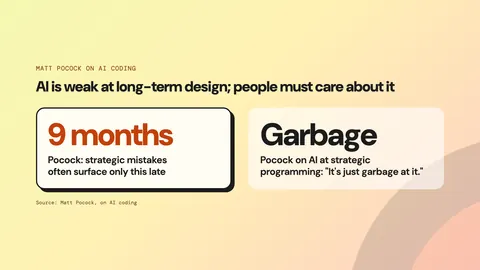
His reasoning starts with training. An agent, he said, is judged on one specific task, so its focus is short term. Strategic mistakes, he added, usually do not come back until around nine months later.
The result, in his words: "the code is the environment your agent operates in, the environment your agent operates in slowly gets worse." Every shortcut becomes the ground the next change stands on.
Pocock gave three examples of how code gets worse. He said an agent will happily produce tests, yet it does not weigh how the code is laid out. He also said "every any in Typescript is a leak"; any is a label that switches off type checking. Finally, he described a measure of whether one edit stays in one place or spreads across many.
Why it matters
Our reading: the delay is what shifts the cost. The person who prompts the agent sees a working feature today. Pocock described problems arriving months later. We would add that they land on whoever maintains the code by then, such as a successor or a client. Pocock did not make that step himself.
For buyers, his three points become questions. Is the code tested and organised in a way anyone can follow? Is type checking switched off in places? Does a small change touch one place or many? Pocock said he assumes his agents will get things wrong, and reviews closely when a change is hard to undo and could do wide damage.
The other side
Pocock conceded agents might be getting better at strategy, though he said they still need to be told to care about it. He also limited his advice: he is not working on a medical or finance application, and for that he would spend a lot on verification first. The conversation offered no measurement of how fast code decays, and the nine-month figure was offhand. Pocock runs AI coding courses, so he has a stake in human judgment mattering. His claim is an experienced practitioner's opinion, not trial evidence.
Written by the WebPulse Newsroom with AI assistance, and checked by our editorial review: every quotation was verified against the recording's transcript. How we use AI.
The conversation this talking point comes from
- NetworkChuck: How to Actually Code with AI (ft. Matt Pocock) (2026-11-20)