- Darryl Campbell said a failure with ordinary causes became an AI conspiracy story because officials explained it badly and many people already distrust AI.
- He said the real AI test comes later, when air traffic control leaves a fragile but well-understood system for an unknown one.
Darryl Campbell, an aviation journalist, argued on the Decoder podcast that public distrust of AI now turns a failure with ordinary causes into a conspiracy story. He said muddled official messaging helps those stories thrive. His bigger worry comes later, when AI replaces legacy processes.
What was said
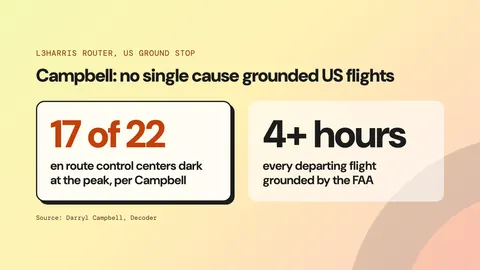
The episode is titled "How one router caused the worst ground stop since 9/11." On Nov. 13, the FAA grounded every departing US flight for more than four hours. Campbell said no single fault could have brought everything down. In his words, "it's kind of like a comedy of errors where no one thing would have caused the entire system to crash."
He pointed to old cabling and networking. Newer vendors, he said, are not equipped to handle the big problems that come with it. He described the old infrastructure as "literally held together with duct tape and aluminum foil".
Other outages hit that week, at Microsoft Outlook, United and Chase Bank. The host said many people guessed at AI-powered cyber attacks or sloppy AI-written code. One theory tied the stop to an AI-based routing system from a contractor called ASI.
Asked if the two were linked, Campbell said, "In a word, no." He said that system mostly replaces manual printouts and routing for controllers. It runs alongside the main systems, he said, and is not plugged into radar or sensitive radio data.
He put the blame on weak messaging, together with a natural dislike of AI. Officials made a few accurate points, he said, then undercut them by adding it could be ten other things.
Why it matters
Our reading: an outage is also a trust event, and the explanation is part of the response. If you run or buy software, a vague first statement may do more damage than the fault. People fill silence with the scariest story available, and AI now fits that role easily.
Our reading of his second point is that he separates people from equipment. He called controllers skilled and said they know how their systems break, so they can keep traffic safe. The cabling is the fragile part. The AI step swaps a fragile system that people understand for one nobody has tested at scale. He expects that test in three to five years, after a full switch.
The other side
Campbell offered no evidence that the new system will fail. His example of moving Chicago over was, by his own admission, made up. His line about that day was personal: "That's the day that maybe I would avoid flying for a little while."
He also said the legacy processes "work pretty well." He did not call flying dangerous either. He argued that airlines and passengers push back on anything that would make the system worse. The excerpts also leave open how a router fault spread to every departing flight.
Written by the WebPulse Newsroom with AI assistance, and checked by our editorial review: every quotation was verified against the recording's transcript. How we use AI.
The conversation this talking point comes from
- Decoder: How one router caused the worst ground stop since 9/11 (2026-11-23)