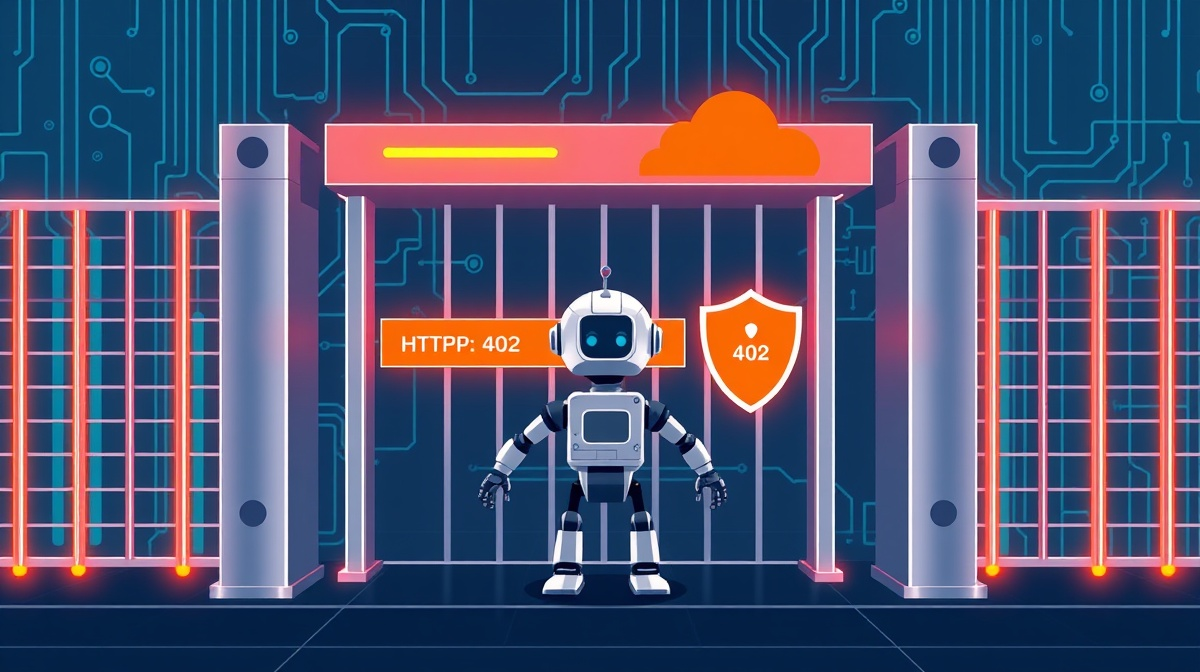
HTTP 402: Payment Required
Cloudflare announced Pay-Per-Crawl — a system that allows any website behind Cloudflare (22.7% of all websites) to automatically block AI crawlers by default and optionally charge them for access via HTTP 402 headers. New Cloudflare sites block AI crawlers out of the box. Existing sites can enable blocking with a single toggle. Publishers who want to monetize AI access set a price per page, and crawlers that agree to pay receive authenticated access tokens.
Stack Overflow is already using the system. Other major publishers are in various stages of adoption. The mechanism is simple: when an AI crawler requests a page, Cloudflare returns HTTP 402 (Payment Required) with pricing metadata. The crawler's operator can accept the terms programmatically, pay, and receive access — or be blocked. No negotiation, no contracts, no sales calls. Machine-to-machine commerce for training data.
Why This Changes Everything
Until Pay-Per-Crawl, AI training data operated on a take-it-or-leave-it model. AI companies crawled the web, ingested content, and trained models. Publishers could block crawlers via robots.txt — but 30% of AI crawlers ignore robots.txt entirely, according to a Tollbit report from 2026. The enforcement mechanism was broken. Cloudflare fixes enforcement by moving it from a text file (robots.txt) to the network layer (HTTP responses with WAF enforcement).
The economic implications are significant. Cloudflare processes 50 billion AI crawler requests per day. If even a fraction of those requests become paid transactions, it creates a new revenue stream for publishers and a new cost center for AI companies. The era of training models on freely crawled web content — the foundation of GPT, Claude, Gemini, and every large language model — is transitioning to a paid access model.
The Framework Dimension
Pay-Per-Crawl introduces a new evaluation criterion for web frameworks: can your framework serve differentiated responses to paid AI crawlers? Frameworks that support middleware-level request classification, content negotiation, and authenticated access are better positioned. FastAPI's dependency injection makes this trivial — a middleware function checks for Cloudflare's crawler authentication token and serves premium content. WordPress's plugin architecture makes this a plugin purchase, a configuration page, and a compatibility prayer.
WebPulse's AI-Readiness scores already measure how well a framework serves machine consumers. Pay-Per-Crawl adds a commercial dimension: frameworks that can serve clean, structured, high-value content to authenticated AI crawlers generate revenue. Frameworks that serve bloated, JavaScript-heavy pages that crawlers struggle to parse miss the monetization opportunity entirely.
The 30% That Ignore robots.txt
Tollbit's data reveals that nearly a third of AI crawlers do not comply with robots.txt permissions. These crawlers ignore the publisher's stated preferences and scrape content regardless. robots.txt is a voluntary protocol — there is no enforcement mechanism. It is a sign on the door that says 'please knock,' and 30% of visitors walk in without knocking.
Cloudflare's approach replaces the sign with a lock. AI crawlers that are not authenticated are blocked at the network layer. They do not receive the page content. They receive HTTP 402 or HTTP 403. The enforcement is technical, not social. This is the shift: from a gentleman's agreement (robots.txt) to an access control system (Cloudflare WAF + Pay-Per-Crawl). Every website not behind a WAF with AI crawler controls is still operating on the gentleman's agreement.
What This Means for the AI-First Web
The AI-first web was built on the assumption that content would be freely available for machine consumption. Pay-Per-Crawl challenges that assumption. If 22.7% of the web starts charging for AI access, the training data landscape fragments. AI companies will need to negotiate access, pay for content, or find alternative data sources. The web becomes a marketplace, not a commons.
For organizations publishing content, Pay-Per-Crawl creates a new decision: block AI crawlers (save bandwidth, preserve exclusivity), allow them for free (maximize visibility in AI-generated responses), or charge them (monetize content directly). Each choice has strategic implications. WebPulse's framework intelligence helps organizations understand which choice their technology stack can actually support — because charging AI crawlers requires the infrastructure to differentiate, authenticate, and serve them. Not every framework can do that.