- Google says AI agents must reach Workspace through its MCP servers or CLI, with enforcement due from February 1, 2027. Ordinary apps can keep using REST APIs.
- The rules give agents their own OAuth client IDs, confirmation prompts for sensitive actions, quotas, and a 30-day limit on derived data such as embeddings.
- Check which agents touch Workspace, whether they still use REST, and what your AI vendors keep after a connection is revoked.
The agent gets its own badge
Until now, access in Gmail or Drive was granted to an app. Google's new Workspace rules grant it to an agent instead, and treat that agent as something different. It gets its own door, its own identity, its own limits and, from April 2027, its own quota billing.
The lesson here is that agents are becoming a separate class of user. They are not a feature of the apps they run inside. Companies that treat them as one more integration will miss what changes.
What Google announced
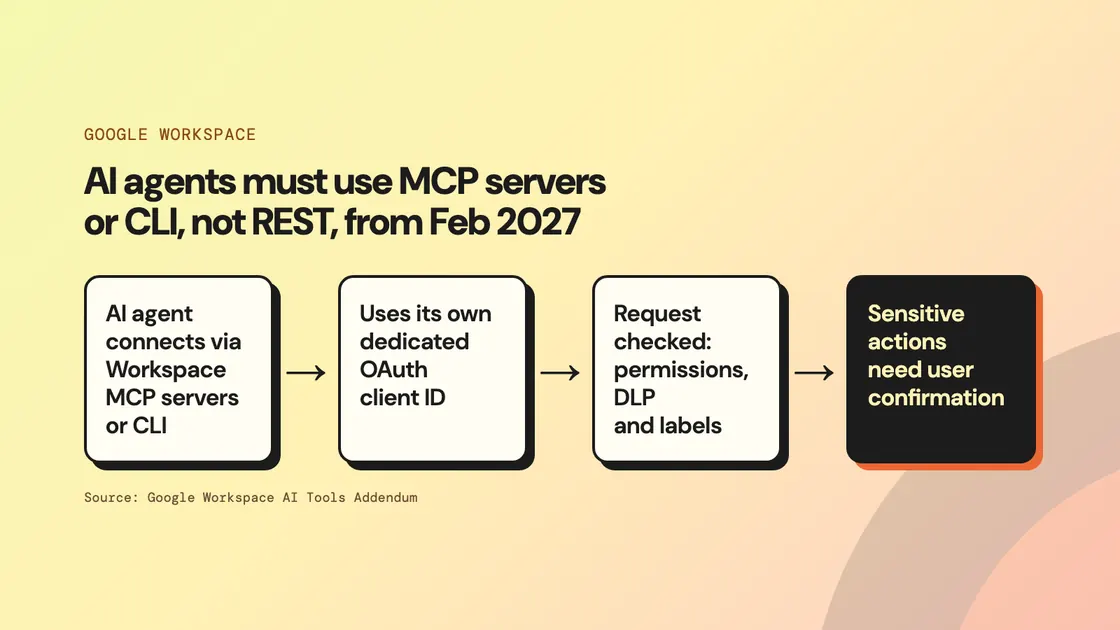
Help Net Security reports that Google announced new security controls for autonomous AI agents across Workspace and Google Cloud. A new contract, the Workspace AI Tools Addendum, sets the main rule. Any AI agent that wants into Workspace must go through one of two Google-run routes: its MCP servers or its command-line tool.
MCP is the Model Context Protocol, an open standard that lets agents reach data and tools. Google plans to start technically enforcing the rule on February 1, 2027. Ordinary apps are not affected. They can keep calling the older REST interfaces, which are how most software talks to Google today.
The servers cover the core Workspace apps, with Keep planned. The command-line tool is meant for agents that run on a local machine and for scripts run from a terminal. It signs in with narrowly scoped OAuth permissions.
How the new door works
Google's Chandu Thota and Brad Calder wrote that "policy checks, data boundaries, and human confirmation have to live in the request path." In practice, each agent request is checked against the organisation's permissions, data loss prevention (DLP) policies and classification labels.
External agents must use dedicated OAuth client IDs. An OAuth client ID is the identity an application shows when it asks for access. A separate ID lets administrators and users tell an agent from an ordinary app in their logs.
The servers and the command-line tool also ask a person to confirm sensitive actions. Google names sending emails, changing Drive sharing permissions and bulk edits. Agents get least-privilege scopes and usage quotas.
Inside Google Cloud, each agent gets its own identity from a service called Agent Registry. No shared or long-lived keys are involved. Cloud customers can also require MFA or human approval before an agent opens sensitive storage buckets, changes IAM permissions or alters production systems.
A new Agent Gateway sits in front of traffic to language models, MCP servers and other agents. It checks each agent's identity and applies IAM policies. It blocks outbound connections unless they are allowed. Requests are also passed to Google's Model Armor service, which looks for prompt injection, meaning hidden instructions planted to hijack an agent. Google says that cancelling a Cloud Agent Identity or an OAuth grant ends the related access straight away.
The rules reach the data agents build
The addendum also governs what AI tool vendors keep. It bans permanent storage of raw Workspace data. It bans using that data to train models. It also bans unauthorized API scraping.
One detail deserves attention. Google caps retention of what it calls Google Technical Information at 30 days. The term covers vector embeddings, memory indexes, user profiles and organizational graphs, which are the working notes an agent compiles from your data. The cap does not apply to user data itself.
Deletion is also required. If a customer disconnects an integration or revokes its access, the vendor must delete the user data and the derived material that goes with it.
This is easy to overlook in a vendor review. The source does not say how Google will check that vendors delete this material, so ask vendors to show it.
What is still to come
Several controls are plans, not features. Google says time-limited approvals will arrive in a future release. Admins can audit agent activity and revoke access today, and Google plans to extend this to users. It also plans restrictions that let admins and users keep external agents away from designated emails, files and folders.
The report does not say how enforcement will spot an agent that calls the REST API directly. The OAuth client ID requirement is the only mechanism it describes. Teams should ask their vendors how they will comply.
Questions for your team
Google advises administrators to review the apps and agents connected to their accounts. It also advises setting DLP policies and watching OAuth activity logs. Developers should move agent integrations to the supported routes before the February 2027 deadline. Beyond that, put these questions to your teams.
Which agents touch our Workspace data today, and do any of them still use REST? Which vendors store embeddings or memory indexes about our staff, and for how long? Who sees the confirmation prompts, and do they read them? Can we revoke one agent's access in minutes, and have we tried?
An agent with its own badge can be counted, limited and switched off. One that borrows an app's badge is much harder to see.
Produced by the WebPulse Newsroom with AI assistance from the original reporting credited below, and checked against that source by our editorial review. How we use AI.
Original reporting: Help Net Security.