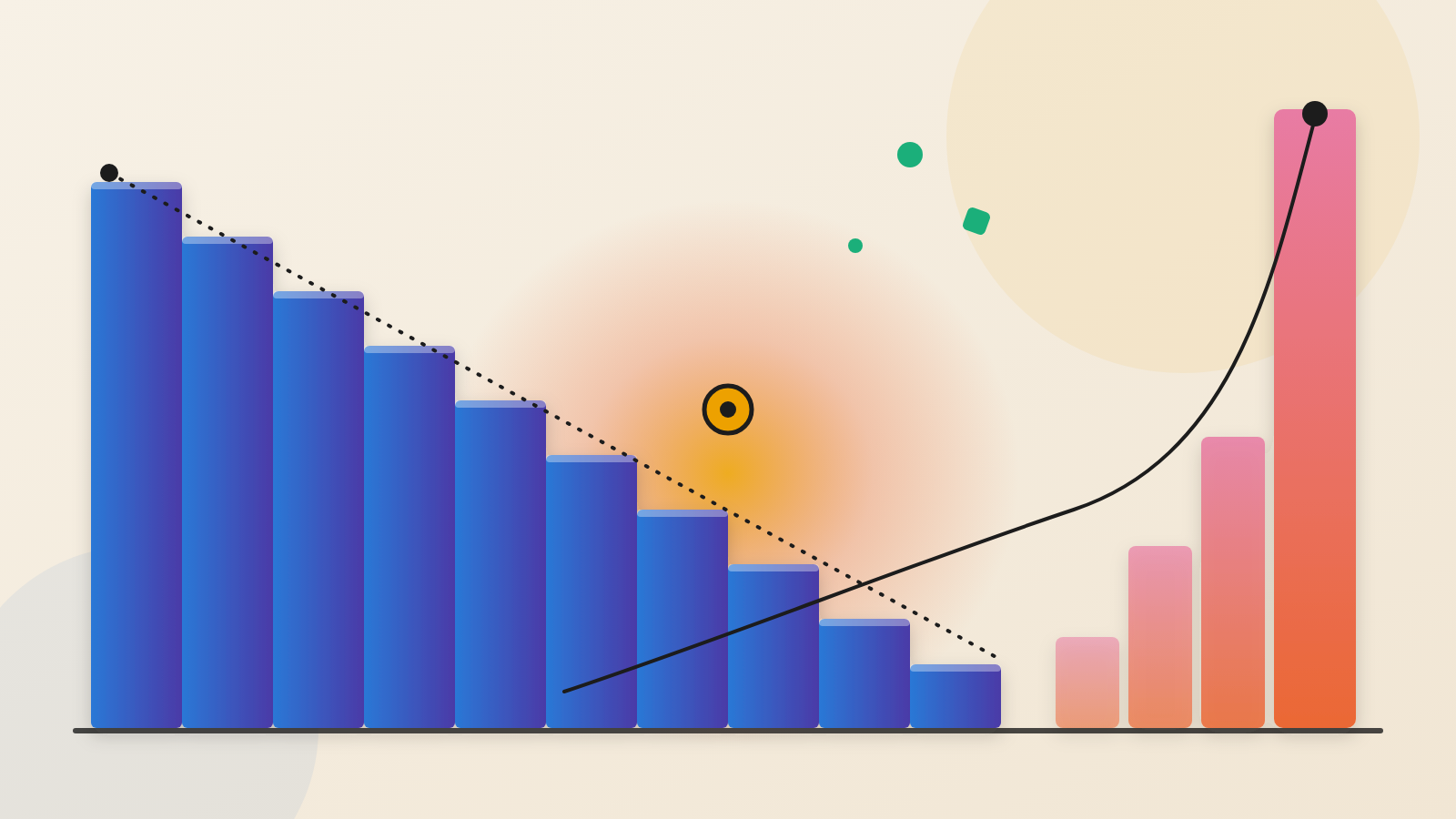
- Gartner forecasts inference cost per agentic workflow will rise more than fivefold through 2028, even though each token costs less to produce.
- Agents use 5 to 30 times more tokens than chatbots, and labs are shifting to pricier frontier models, so total bills grow.
- Leaders should demand per-workflow cost tracking, cost-per-outcome targets, model tiering and automatic spend limits on agents.
A lower price is not a lower bill
A price cut tells you what one unit costs. It says nothing about how many units you will buy. AI agents change that second number, and that is the idea at the center of a new Gartner forecast.
Through 2028, Gartner projects, the inference cost of each agentic workflow will grow by a factor of more than five. Inference is the work a model does each time it answers. The firm expects this even as the cost of making each token improves. A token is the small chunk of text a model reads or writes, and it is the unit AI providers bill by. Gartner calls the gap the Inference Paradox, and described it to VentureBeat.
How cheaper tokens still add up to more spend
Gartner's Will Sommer points to two forces. The first sits with the model labs. Tokens are cheaper to generate, but he says the labs are not banking the savings. They are building next-generation models that need more computing power and cost more per token.
The result is a split. Older capabilities get cheaper while frontier models get pricier. His example is Anthropic's Fable, which charges a higher rate per token than Opus does.
The second force sits with the buyer. Cheaper tokens make harder jobs practical, and harder jobs use far more tokens. Sommer said agents need 5 to 30 times more tokens than a basic chatbot for the same task. An agent plans, calls tools, checks its work and tries again. Each step is another round of billable text.
Gartner also puts a floor under a single task. Sending it to an agentic reasoning model costs the provider at least five times what a plain chatbot exchange would. The gap often grows far wider as the task gets harder. Rivalry keeps the cycle turning. A firm that wants to match its peers takes on tougher jobs, and those need stronger, costlier models and many more tokens.
The old rule: efficiency lowers the bill. The new one: it widens the use.
Economists have seen this pattern before. When engines used fuel more efficiently, total fuel use often rose, because cheaper travel invited more of it. Cheap tokens invite the same appetite. The lesson here is that the unit price is a fact about the supplier. The size of the bill is a fact about your design.
Gartner does not expect a smooth climb. Sommer said spring brought a large jump in spending, driven partly by the "tokenmaxxing fad." He says companies are now in a belt-tightening phase. Gartner expects more waves as reasoning agents and world models mature.
One caution. This is a forecast from Gartner's Tokenomics Forecast, an econometric model with more than 300 inputs, per Sommer. VentureBeat's report does not list those inputs, so readers cannot check the model themselves.
One in five orchestration-platform users has no automatic brake on agent spending
VB Pulse surveyed 109 qualified respondents in September. Among enterprises that run an orchestration platform, which is software that coordinates agents, 21% have no automatic cutoff for agent token spending. A further 31% hold costs down by steering routine, high-volume agent work to lower-priced models.
The sample is small and limited to orchestration-platform users, so it says little about firms in general. It still shows the practical risk for a finance lead. An agent that loops or over-thinks does not fail loudly. It runs up a bill. Picture the engineer who finds the overrun at month-end and the finance team that has no per-task figure to explain it.
What to ask your team
Sommer's advice reads as five controls. Each translates into a question you can put to your teams this quarter.
First, observability. Can we see token spend per workflow, per task? Sommer said enterprises "cannot optimize what they cannot observe." Second, outcomes. What is the cost per case closed or task automated, and which workflows should be fixed or retired?
Third, tiering. Which tasks default to a frontier model, and can routine ones be routed to cheaper models automatically? Fourth, standards. Have we stress-tested each deployment against token-price swings and compliance costs before approving it? Fifth, data. Where could a smaller model tuned on our own data do the job reliably? Sommer's view is that focused, domain-specific models usually beat general frontier models on reliability for particular workloads.
Ask for a hard spending limit on every agent that runs unattended. A falling price list is not a budget control.
Produced by the WebPulse Newsroom with AI assistance from the original reporting credited below, and checked against that source by our editorial review. How we use AI.
Original reporting: VentureBeat.