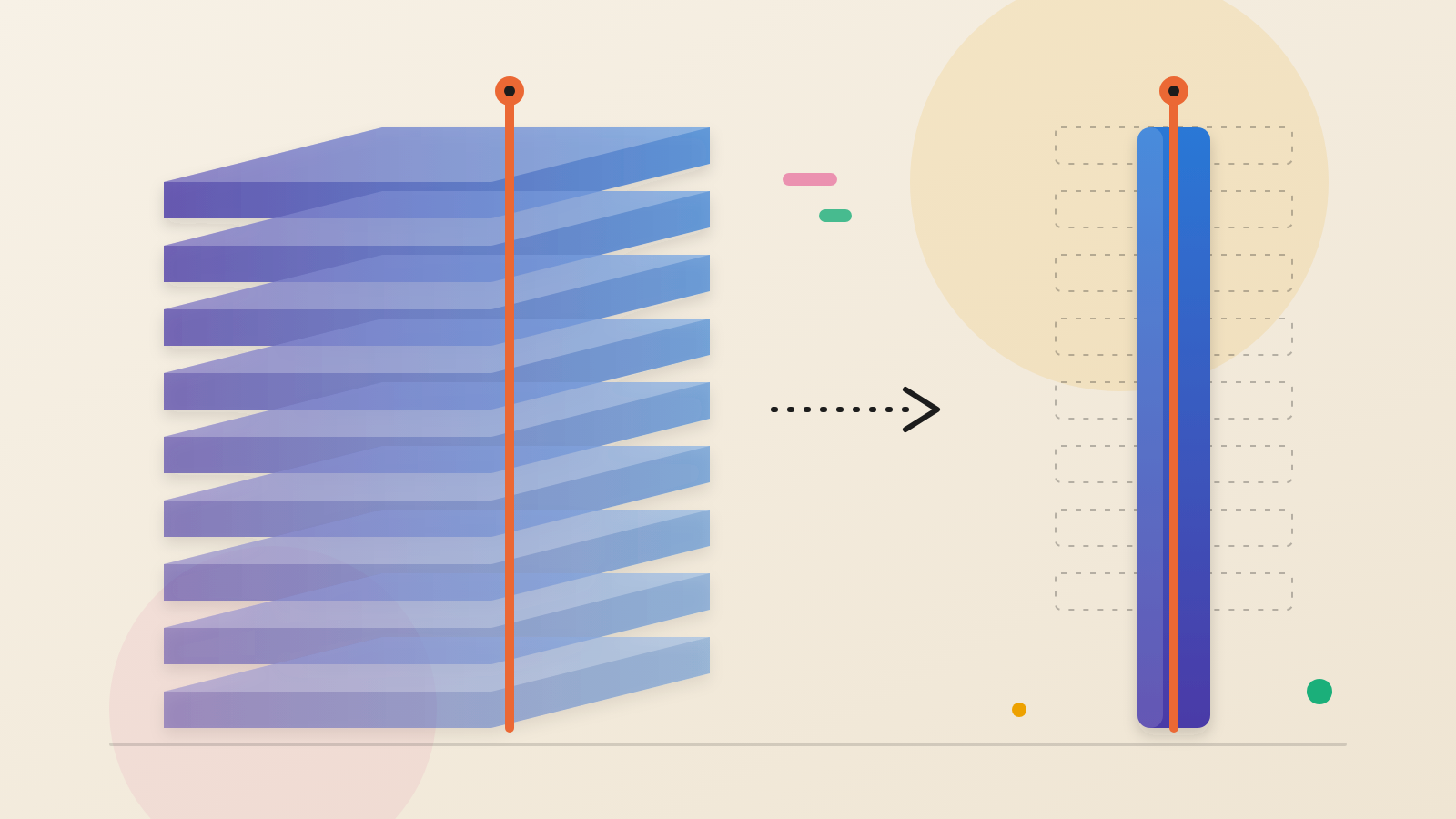
- Cloudflare has previewed Clairic, a model that returns typed values from text and images instead of generating prose. It is hosted on Workers AI.
- Cloudflare's own test of a damaged-product claim pipeline ran in 19.3 seconds against 61.7 for an all-LLM version. Results come from one vendor test.
- Leaders can ask which AI calls are really extraction, and whether the model that writes replies needs to see raw customer text.
Reading is not writing
Many AI tasks in a company are reading tasks. What is the invoice total? When did the parcel arrive? How much will the repair cost? We usually hand these to a model built to write fluent text. That is a design choice, and it has costs.
Cloudflare has just put a different choice on the table. On October 19 it announced a preview of Clairic, which it calls an extraction model. The idea is simple. A model that only needs to return a value should not have to generate prose to do it. This piece reads that idea through Cloudflare's own announcement. Its numbers are vendor results, not independent tests.
What Cloudflare announced
Cloudflare offers the Clairic preview through its Workers AI platform. It says it intends to release the model's open weights soon. It places Clairic in a family it calls System One models, a label it credits to TypeSafe, which introduced a model named Jev a month earlier. The name borrows from Daniel Kahneman's contrast between fast, intuitive thinking and slow, deliberate reasoning.
The earlier System One models, such as Jev and Clef, were decision models. They pick among options you list and give a probability for each. Clairic is the first of a new kind. It returns values taken from the input, computed from it, or estimated beyond it.
How it works
To use it, a developer sends the document text, with as many as four images if needed, plus a list of questions. Each question has a name, an expected data type and optional notes in everyday language. The model returns one typed answer per question.
Cloudflare says the model works in a single pass, with no reasoning step and no output tokens. So you pay only for input, and replies typically arrive in under a second. Cloudflare argues that a model which writes no words cannot garble an answer the way a chatbot can. It adds that the model can still be wrong.
When the answer is not in the document, the model returns an empty result instead of inventing one. Each single-value answer carries p_null, the probability that the value is absent, and a confidence score. Estimates come with a median and an 80% interval, running from the 10th to the 90th percentile. A narrow interval signals high certainty. A wide one is a cue to send the item for another check.
The security angle: shrink what the writer sees
The most interesting part is the pipeline Cloudflare built around a damaged-product claim. Clairic pulls values from the customer's email. Clef, a decision model, rules on a five-line summary of those values. An LLM then writes the reply.
Cloudflare notes that a free-form email can be open to prompt injection, where hidden instructions in text steer a model. In this design the writing model gets just the verdict and the figures it needs. The raw email stays out of its reach. Cloudflare adds that each stage produces structured output that can be checked, and only the last stage writes free text.
This shows a useful principle. Each model that reads untrusted text is a place where that text can misdirect it. Fewer such places means less exposure. Cloudflare does not claim the design removes the risk, and no independent test is offered.
What the test showed, and what it did not
Cloudflare compared the staged pipeline with an all-LLM version, using GLM-5.3 to write the reply in both. It timed the staged version at 19.3 seconds. The all-LLM version took 61.7. Cloudflare puts the saving at 69% and says the staged pipeline also costs 49% less.
For extraction and the decision alone, Cloudflare says Clairic and Clef together needed under a second. GLM-5.3 spent 38 seconds on those same two steps.
Quality was mixed in an informative way. On the facts and the final decision, the two pipelines matched across all runs. The gap showed up in the repair cost. Clairic gave the same estimate each time. GLM-5.3's moved between runs: $250, $250 and $220. Cloudflare also says Gemma 4 and Qwen failed the all-LLM version because they could not deduce values like repair cost.
These are results from one pipeline and one vendor's setup. They show a direction, not a benchmark for your documents.
Cloudflare also ran a forecast test on public TSA checkpoint counts, asking for the next day's total on 21 days in a row. The average error was 3.3%. Seventeen of the 21 actual counts fell inside the 80% interval. Three of the four misses fell on the Columbus Day weekend. Cloudflare explains that the model forecasts from patterns in the series and cannot know about holidays the data does not show. It says Clairic is not meant to replace a dedicated time-series model.
Questions to put to your team
First, which AI calls in your business only extract values from documents? Those are candidates for a typed approach. Second, does the model that writes customer replies need to see raw customer text, or only a checked summary?
Third, do your estimates carry a range, or only a single number? A confident $180 and an unsure $180 look the same downstream. Fourth, how will you test on your own documents? Clairic is a preview on an early checkpoint, and Cloudflare says it expects it to improve.
The lesson is not that one model type wins. It is that separating reading, deciding and writing gives each step less to get wrong. That also gives you somewhere to check the work.
Produced by the WebPulse Newsroom with AI assistance from the original reporting credited below, and checked against that source by our editorial review. How we use AI.
Original reporting: Cloudflare.