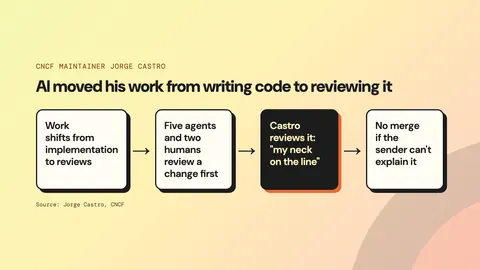
- Jorge Castro of the CNCF said agent contributors make reviewing, not implementing, the main work, so he batches reviews and still approves every change himself.
- He keeps his agent experiment off Kubernetes because it has to be protected, and tries it on Project Bluefin instead.
Jorge Castro of the CNCF argued that once AI agents write the code, the scarce work becomes reviewing it. He made the point in a GitHub Universe 2026 talk, "What open source can teach us about agents in CI/CD," on GitHub's show. The CNCF is the foundation that hosts Kubernetes.
What was said
Castro runs a system called Hive on Project Bluefin, an open source operating system project. In it, agents act like a software team. A supervisor agent wakes about every ten minutes and checks the project's repositories. If a build is failing, a CI agent fixes it and sends a pull request, which is a proposed code change.
Contributors with spare AI capacity can connect their own agents, which then take on tasks. A review agent comments on every pull request. By the time a change reaches Castro, five agents and two humans have looked at it.
That changes the work. Castro said: "All of a sudden it's all about reviews, not so much about implementation." He said humans still have to triage, because automated triage has not worked well for him.
Castro also said he will not merge work from a contributor who cannot explain what they sent. Full autonomy is possible, he said, but shipping that way to live devices terrifies him. He said "it's my neck on the line and I'm the one that pushes the button."
Why it matters
Our reading: agents make a pull request cheap to produce. The limit on safe change then becomes how many reviews a person can responsibly do.
For managers who buy or build software, that suggests two questions for any agent demo. Who reviews what the agent produces? How much can one reviewer take on?
Castro also said he cannot run this experiment in Kubernetes because it has to be protected, so he tries it on his own project. A fair question for any vendor: where was its agent workflow first proven? Did that place have real stakes?
The other side
Castro offered no figures on defects caught or missed. So the talk does not show that five agents plus two humans is enough. It also does not show that one maintainer can keep up as volume grows.
He did not say Bluefin runs in full autonomy. He described it as one end of a range and said humans approve. He also said he keeps separate guides for human and agent contributors because he has not worked out a better way. The talk leaves open whether this approach could ever suit a project as critical as Kubernetes.
Written by the WebPulse Newsroom with AI assistance, and checked by our editorial review: every quotation was verified against the recording's transcript. How we use AI.
The conversation this talking point comes from
- GitHub: What open source can teach us about agents in CI/CD (2026-11-21)